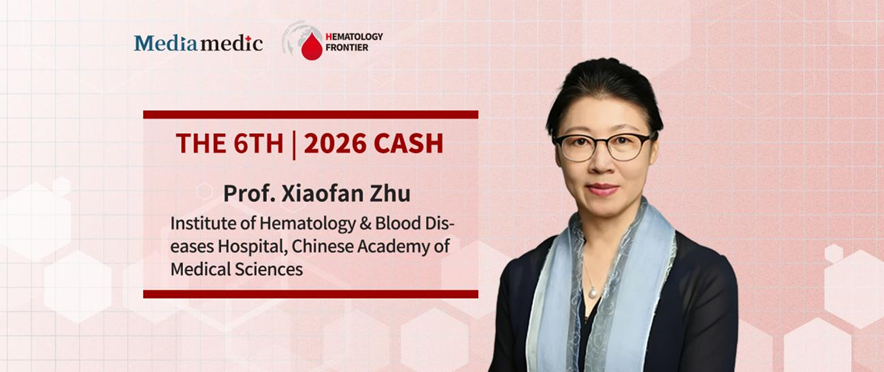
Editor’s Note At the beginning of the new year, distinguished experts gathered in Tianjin. From January 9 to 11, 2026, the 6th China Congress on the Advancement of Hematology (CASH) was grandly held in Tianjin. The conference brought together leading domestic and international experts in hematology, focusing on cutting-edge scientific advances and national health priorities. Through in-depth academic exchange, participants explored new directions for disciplinary development. During the meeting, Oncology Frontier – Hematology Frontier invited Xiaofan Zhu, Professor at the Institute of Hematology and Blood Diseases Hospital, Chinese Academy of Medical Sciences, to systematically interpret the latest advances in pediatric hematology and oncology—drawing on key findings from the American Society of Hematology (ASH) 2025 Annual Meeting—with a focus on immunotherapy, targeted therapy, basic mechanisms, and long-term survivorship management, providing forward-looking insights for pediatric hematology practice and discipline development in China.
Oncology Frontier – Hematology Frontier:
At the 2025 ASH Annual Meeting, which research findings or clinical trial advances in pediatric hematology and oncology impressed you the most? How have these advances changed treatment concepts or clinical strategies?
Professor Xiaofan Zhu: At this year’s ASH Annual Meeting, pediatric hematology achieved important progress across multiple disease areas. In pediatric acute lymphoblastic leukemia (ALL), immunotherapy continues to play a central role. In particular, for relapsed central nervous system leukemia in children, CAR-T cell therapy has demonstrated promising clinical potential, and results from international studies are highly encouraging.
In pediatric acute myeloid leukemia (AML), an increasing number of studies are exploring the application of adult treatment regimens in children. These approaches have shown relatively favorable efficacy in both newly diagnosed and relapsed/refractory cases. Overall, the trend suggests that with the integration of targeted agents, pediatric AML may follow a trajectory similar to ALL—achieving improved outcomes while further reducing the toxicities associated with traditional chemotherapy.
In basic research, accumulating evidence indicates that certain leukemia-associated driver gene mutations may arise as early as the embryonic stage and play a key role in disease initiation and progression. This discovery not only deepens our understanding of leukemogenesis but also provides a scientific basis for addressing parents’ concerns regarding disease origins. In addition, epigenetic alterations such as abnormal DNA methylation are increasingly recognized for their potential value in early screening.
Moreover, noteworthy progress has also been reported in pediatric hematopoietic stem cell transplantation, lymphoma, bone marrow failure syndromes, and myeloproliferative disorders, all of which merit close attention.
Oncology Frontier – Hematology Frontier:
Looking back over the past year, where do you see the most breakthrough advances in pediatric hematologic diseases and tumors? What important implications do these annual advances have for clinical practice in China?
Professor Xiaofan Zhu: In pediatric hematologic malignancies, ALL and AML remain the most common disease types. Among them, therapeutic advances in pediatric ALL have progressed more rapidly. In recent years, the continuous emergence of novel therapies—including small-molecule targeted agents and immune-targeted drugs—has profoundly transformed the overall treatment paradigm for pediatric leukemia, particularly ALL.
The core of this transformation lies in the substantial reduction of toxicity associated with conventional chemotherapy. At the CACA Conference held this year, I delivered a keynote lecture entitled “New Strategies in the Treatment of Pediatric Leukemia,” emphasizing optimization of therapy by reducing chemotherapy intensity without compromising efficacy. This progress has not only significantly improved treatment outcomes but has also markedly enhanced patients’ quality of life.
Oncology Frontier – Hematology Frontier:
Based on cutting-edge research from ASH 2025 and recent technological advances, how do you view future trends in pediatric hematology and oncology? Which areas deserve the most attention in terms of precision therapy, long-term follow-up, and quality-of-life improvement?
Professor Xiaofan Zhu: With continuous advances in therapeutic approaches, outcomes for children with hematologic diseases have steadily improved, and overall cure rates have risen significantly. However, for pediatric patients, disease remission and cure are not the ultimate endpoints. More importantly, we must ensure long-term quality of life, enabling children to grow, learn, and adapt socially in ways comparable to their healthy peers.
Therefore, while maintaining a focus on therapeutic efficacy and adhering to the principle of “reducing toxicity while enhancing efficacy,” long-term follow-up and survivorship management are becoming increasingly important. This includes systematic evaluation of physical and psychological development and overall quality of life in long-term survivors. In recent years, this issue has attracted growing attention in pediatrics, and we will continue to invest efforts and exploration in this area moving forward.
Expert Profile
Xiaofan Zhu, MD, PhD Chief Clinical Expert Institute of Hematology and Blood Diseases Hospital, Chinese Academy of Medical Sciences
- Chief Physician, Doctoral Supervisor
- Recipient of the State Council Special Government Allowance
- Distinguished Expert of Tianjin Municipality
- Vice Chair, National Health Commission Pediatric Leukemia Expert Committee
- President-Elect, Pediatric Oncology Committee, Chinese Anti-Cancer Association
- Head, Hematology Group, Pediatric Branch, Tianjin Medical Association
- Vice Chair, Tianjin Pediatric Oncology Committee
- Editorial Board Member, Chinese Journal of Pediatrics, Chinese Journal of Hematology, among others
- Recipient of the National Natural Science Award (Second Prize), Song Qingling Pediatric Medicine Award, Wu Zhou Women’s Science and Technology Award, Tianjin Natural Science Award (First Prize), and other honors