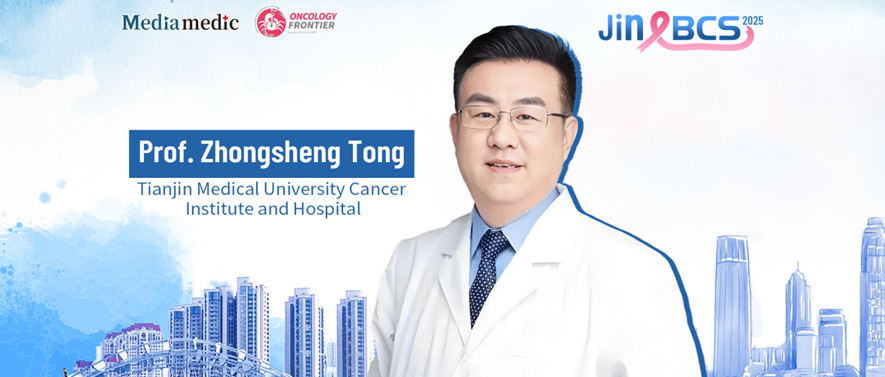
Editor’s Note Recently, the 2025 Tianjin International Breast Cancer Conference, hosted by the Chinese Anti-Cancer Association and co-organized by Tianjin Medical University Cancer Institute and Hospital together with the National Clinical Research Center for Cancer, was held in Tianjin. Focusing on cutting-edge developments in breast cancer, the conference brought together many renowned domestic and international experts to engage in in-depth discussions on new advances in diagnosis and treatment. At the meeting, Professor Zhongsheng Tong from Tianjin Medical University Cancer Institute and Hospital delivered a keynote lecture titled “The Latest Advances in Targeted Drug Therapy for Breast Cancer”, systematically reviewing major breakthroughs and emerging directions in the field over the past year. Following the conference, Oncology Frontier invited Professor Tong for an in-depth discussion of his presentation and perspectives on discipline development.
01
Oncology Frontier: Your lecture at the 2025 Tianjin International Breast Cancer Conference was titled “The Latest Advances in Targeted Drug Therapy for Breast Cancer.” Could you share the key highlights of this presentation?
Professor Zhongsheng Tong: This year has been highly productive for the field of breast cancer, with many influential studies reported at major domestic and international conferences and published in leading journals. My presentation focused mainly on several key areas.
The first area was progress in antibody–drug conjugates (ADCs). In this field, multiple clinical studies targeting HER2-positive breast cancer have achieved breakthrough results, among which the findings from the DB-11, DB-09, and DB-05 trials are particularly noteworthy. The DB-11 study focused on neoadjuvant therapy for HER2-positive breast cancer and included three treatment arms: T-DXd plus THP, T-DXd monotherapy, and ddAC plus THP. Results presented at the 2025 ESMO Annual Meeting showed that the study met its primary endpoint. The T-DXd–THP arm achieved a pathological complete response (pCR) rate of 67.3%, significantly higher than the 56.3% observed in the ddAC–THP arm, with an absolute difference of 11.2%. These results are expected to influence updates to relevant clinical guidelines next year.
The DB-05 study focused on patients with HER2-positive breast cancer receiving neoadjuvant therapy and evaluated the efficacy and safety of T-DXd versus T-DM1 as adjuvant treatment in high-risk early-stage patients with residual invasive disease after neoadjuvant therapy. This head-to-head comparison between T-DXd and T-DM1 also demonstrated clearly positive results.
In addition, the DB-09 study demonstrated favorable efficacy of T-DXd as first-line treatment for advanced HER2-positive breast cancer.
Taken together, this year has seen major advances across the spectrum of HER2-positive breast cancer care, including neoadjuvant therapy, intensified postoperative adjuvant treatment, and first-line therapy for advanced disease. At the same time, significant progress has also been made in HER2-low populations through the DB-04 and DB-06 studies. From early single-target and dual-target strategies to the current era of ADCs, treatment paradigms for HER2-positive breast cancer continue to evolve. Notably, ADCs independently developed in China have begun to stand out on the international stage, with agents such as SHR-A1811 demonstrating promising potential across different stages of clinical research. With the strong performance of domestically developed anti-HER2 ADCs, further optimization of clinical practice is expected in the coming year.
Beyond HER2-targeted ADCs, substantial progress has also been made in drugs targeting Trop-2. China’s original Trop-2 ADC sacituzumab tirumotecan (SKB264) has shown promising efficacy in both triple-negative breast cancer and HR-positive/HER2-negative breast cancer, with the potential to further reshape clinical practice in the future. Among reported Trop-2 ADCs, Dato-DXd has demonstrated a favorable balance between safety and efficacy, with a relatively high drug-to-antibody ratio (4:1) and good tolerability. Another Trop-2 ADC, sacituzumab govitecan (SG), has already achieved positive results in triple-negative breast cancer and is now being explored in first-line settings. Studies have shown that SG combined with pembrolizumab provides significant survival benefits in PD-L1–positive patients.
Currently, the clinical application of Trop-2 ADCs is expanding from triple-negative breast cancer to HR-positive/HER2-low or HER2-negative populations, with treatment lines moving from later-line to first-line therapy. Particularly encouraging results have been observed when combined with immunotherapy, highlighting broad clinical potential. As multiple ADCs targeting HER2 and Trop-2 continue to emerge—such as T-DXd, SG, and potentially Dato-DXd—treatment options will become increasingly diverse, allowing for further optimization of individualized therapeutic strategies.
Another major component of my presentation addressed advances in CDK4/6 inhibitors. Both abemaciclib and ribociclib have attracted sustained attention. At the October 2025 ESMO Congress, both agents demonstrated significant clinical benefits in postoperative adjuvant intensification therapy for HR-positive/HER2-negative early breast cancer. Ribociclib showed sustained efficacy advantages in the adjuvant setting, with excellent five-year follow-up results from the NATALEE study and a trend toward overall survival (OS) benefit. Meanwhile, the monarchE study of abemaciclib has now accumulated up to seven years of survival data, further confirming its long-term value in adjuvant therapy. It is worth noting that the two drugs differ in their eligible patient populations, with the NATALEE study adopting broader inclusion criteria, which may translate into wider applicability in clinical practice.
At the same time, the domestically developed CDK4/6 inhibitor dalpiciclib has achieved important breakthroughs in the adjuvant setting. The DAWNA-A study, jointly led by Professor Zhiming Shao from Fudan University Shanghai Cancer Center and Professor Jihui Hao from Tianjin Medical University Cancer Institute and Hospital, is currently the largest clinical study of its kind in China, enrolling 5,274 patients, nearly 500 of whom were contributed by our hospital. Recently published results demonstrated that adding dalpiciclib to standard postoperative adjuvant therapy significantly improved invasive disease–free survival (IDFS). With longer follow-up, OS data are eagerly anticipated. We look forward to broader availability and expanded indications for this drug to benefit more patients in China.
I also discussed progress in PAM pathway inhibitors. These agents are currently most commonly used in HR-positive/HER2-negative advanced breast cancer after progression on CDK4/6 inhibitors. PI3K inhibitors, AKT inhibitors, and mTOR inhibitors have all been approved in China. Numerous clinical studies—including INAVO120 and CAPItello-291—have shown that both AKT and PI3K inhibitors can provide meaningful efficacy even after CDK4/6 inhibitor progression. In addition, research focusing on patients with ESR1 mutations is ongoing, particularly in the post–CDK4/6 inhibitor setting. ESR1 mutations are commonly seen after prolonged aromatase inhibitor therapy, and several studies evaluating targeted therapies for this population are underway. Our team has participated in multiple international multicenter studies, with recent publications reporting favorable outcomes for oral selective estrogen receptor degraders (SERDs) targeting ESR1 mutations.
Overall, the breast cancer field has achieved highly productive research outcomes this year. Novel ADCs and multi-target antibody-based therapies continue to emerge, offering new therapeutic directions. Updates to clinical consensus guidelines and in-depth interpretation of the latest drugs and data provide a stronger foundation for advancing clinical practice.
02
Oncology Frontier: As Vice President of the Binhai Hospital of Tianjin Medical University Cancer Institute and Hospital, how does the breast specialty center achieve homogeneous diagnosis and treatment across multiple campuses under the “one hospital, multiple campuses” model? What replicable experience can you share in terms of resource integration, talent sharing, and patient referral?
Professor Zhongsheng Tong: Following the complete relocation of the Binhai Hospital in July 2023, we indeed faced many new challenges, including increased geographic distance, personnel deployment, adjustment of disciplinary layouts, and coordination of research directions. After the relocation, hospital leadership at the main campus acted swiftly and implemented systematic planning at the policy level, focusing on two core principles: first, adhering to unified leadership under the Party Committee, with major decisions made collectively at the hospital level; second, within this framework, granting the Binhai campus an appropriate degree of autonomy. I believe this approach has been highly effective and has promoted disciplinary development to a significant extent. After several years of operation, we have seen clear upward trends in overall scale, physician training, workforce stability, and clinical performance indicators.
In addition, we have achieved full homogeneity between the two campuses through digital health solutions. Despite the physical distance, our information systems are fully integrated, enabling real-time mutual recognition and sharing of examination results, imaging data, laboratory reports, and prescription information. This integration prevents unnecessary patient travel and enables seamless continuity of care. By adopting a patient-centered approach—where patients remain in place while physicians actively coordinate care—we have realized synchronous management and coordinated development across campuses. The current operational model is relatively mature, and its effectiveness is reflected in steady growth in outpatient visits, surgical volume, and particularly the number of malignant tumor surgeries, demonstrating its positive impact on enhancing clinical service capacity.
Talent development has also been a key priority. In line with hospital directives, we have placed particular emphasis on cultivating reserve talent, leveraging internal programs such as the “Shuren Plan” to provide young physicians with balanced platforms for both clinical practice and research. We also actively create opportunities for overseas training and academic exchange to strengthen talent reserves. We firmly believe that the core of high-quality hospital development lies in people. Moving forward, hospital leadership at all levels will continue to uphold this philosophy, strengthen talent development, promote sustained disciplinary advancement, and further deepen translational medicine and basic research, ultimately delivering higher-quality care to our patients.

Professor Zhongsheng Tong Department of Breast Medical Oncology Tianjin Medical University Cancer Institute and Hospital