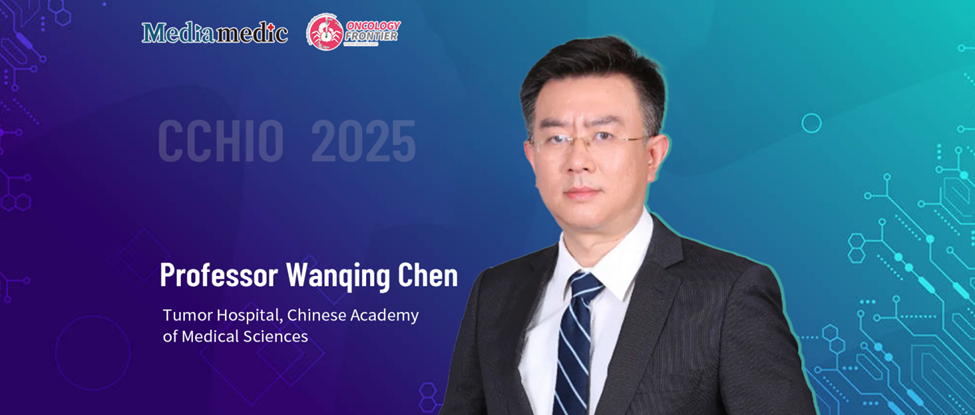
Editor’s Note : From November 6–9, 2025, the China Conference on Holistic and Integrative Oncology (CCHIO) was held in Kunming, bringing together leading oncology experts from across China and abroad. At the conference, Professor Chen Wanqing of the National Cancer Center / Cancer Hospital, Chinese Academy of Medical Sciences (CAMS), delivered a keynote report titled “Current Status and Challenges of China’s Cancer Burden.” He provided a comprehensive analysis of cancer epidemiology in China, shifts in disease profiles, public health priorities, and strategies for cancer control. Oncology Frontier interviewed Professor Chen at CCHIO to discuss how understanding China’s cancer burden can inform the future direction of early detection and diagnosis.
01
Oncology Frontier: You presented a report on “The Current Status and Challenges of China’s Cancer Burden.” How would you describe China’s overall cancer burden today, and what are the notable trends in the cancer spectrum?
Professor Chen Wanqing:
According to the latest data published by the National Cancer Center in its 2022 China Cancer Incidence and Mortality Epidemiology Annual Report (released in 2024), China reports 4.82 million new cancer cases and 2.57 million cancer deaths each year—numbers that continue to rise.
Over the past two decades, both incidence and mortality have increased in absolute numbers. Encouragingly, however, the age-standardized cancer mortality rate has been declining at an average of 1.3% per year, which is a positive trend.
China’s cancer spectrum has also changed significantly in recent years:
- Lung cancer has surpassed breast cancer to become the second most common cancer among women.
- Thyroid cancer is increasing rapidly and is now the third most common malignancy in women and the seventh in men.
- Prostate cancer now ranks sixth among newly diagnosed male cancers and continues to rise steadily.
These shifts are likely related to population aging and the accumulation of risk factors.
02
Oncology Frontier: Given the current cancer landscape in China, what challenges remain for public health strategies, and what areas of cancer control need improvement?
Professor Chen Wanqing: Under the guidance of the Healthy China Initiative—Cancer Control Action Plan (2023–2030), we are striving to achieve the goal that China’s overall 5-year cancer survival rate reaches 46.6% by 2030.
In the short term, reducing overall cancer incidence is difficult. Improving public awareness, increasing early detection, and raising the proportion of early-stage diagnoses are the most effective ways to improve 5-year survival.
However, several key challenges remain:
- Participation in cancer screening programs is still low.
- Public awareness and willingness to undergo screening need to be strengthened.
- Screening programs are mostly implemented through national public health projects; voluntary participation is limited.
- Medical resources are unevenly distributed—many primary healthcare institutions lack equipment and trained personnel.
- Large-scale screening and early diagnosis programs are difficult to implement effectively in many regions.
These are the areas that require focused improvement moving forward.
03
Oncology Frontier: Your work on integrated tumor sample research is accelerating the translation of early cancer detection into clinical practice. What changes could this research bring to China’s cancer screening landscape?
Professor Chen Wanqing: Early cancer screening and secondary prevention are the most effective ways to reduce the cancer burden and increase the 5-year survival rate.
Currently, some screening technologies still have limitations. For example, endoscopic screening for gastrointestinal cancers is invasive and does not fully meet the principles of population screening. Our goal is to develop non-invasive, precise, feasible, and affordable screening tools.
Globally, scientists are developing new methods, including multi-omics approaches for biomarker discovery that enable early detection across multiple cancer types. These advances have already achieved major breakthroughs and are approaching clinical translation.
The Tumor Sample Integration Research Committee of the China Anti-Cancer Association is also working to strengthen foundational research on cancer biomarkers and develop new screening technologies that can eventually be applied in real-world screening programs.
04
Oncology Frontier: Looking ahead, what do you consider the ideal state for cancer screening and early diagnosis in China?
Professor Chen Wanqing: the ideal future model is a combination of organized screening and opportunistic screening.
- Organized screening: Requires increased national investment, optimized health policies, and sustainable support through medical insurance or public welfare programs. This allows a greater proportion of the population to access high-quality screening services.
- Opportunistic screening: Requires improving public awareness of screening so that individuals understand their own cancer risks and proactively undergo regular examinations.
By advancing these two approaches simultaneously, we can significantly increase early diagnosis rates and achieve the 2030 goal of improving the national cancer survival rate.
Professor Chen Wanqing

Researcher, Ph.D., Doctoral Advisor Director, National Central Cancer Registry National Cancer Center / Cancer Hospital, Chinese Academy of Medical Sciences