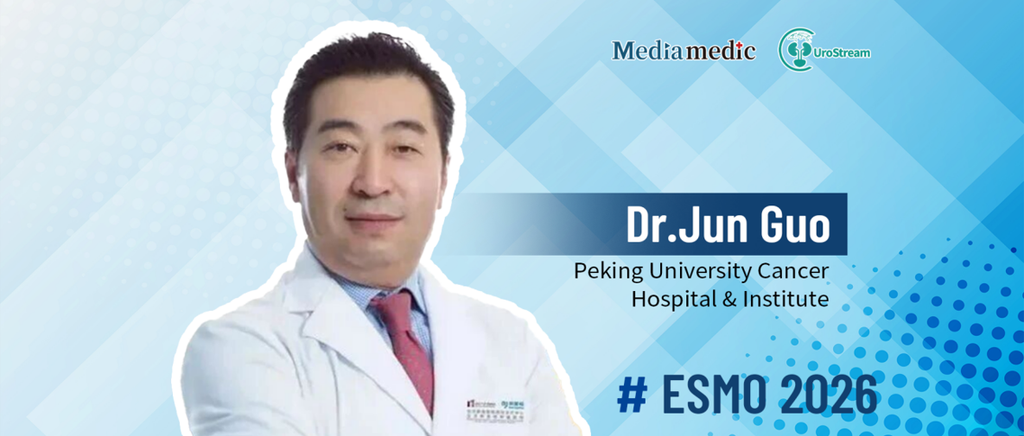
Professor Jun Guo: Addressing Unmet Clinical Needs to Explore a New Treatment Approach for Favorable-Risk Renal Cell Carcinoma — Balancing Tumor Control with Long-Term Tolerability: The Rationale Behind Ivonescimab

Professor Jun Guo: Addressing Unmet Clinical Needs to Explore a New Treatment Approach for Favorable-Risk Renal Cell Carcinoma — Balancing Tumor Control with Long-Term Tolerability: The Rationale Behind Ivonescimab

During the 2026 European Society for Medical Oncology (ESMO) Congress, first-line treatment options for patients with favorable-risk advanced renal cell carcinoma (RCC) attracted considerable attention. For this patient population, how to control disease while reducing the burden of long-term treatment remains an important question warranting further investigation. Oncology Frontier – UroStream invited Professor Jun Guo of Peking University Cancer Hospital to discuss the patient selection, dual-target blockade strategy, and potential clinical value of ivonescimab.
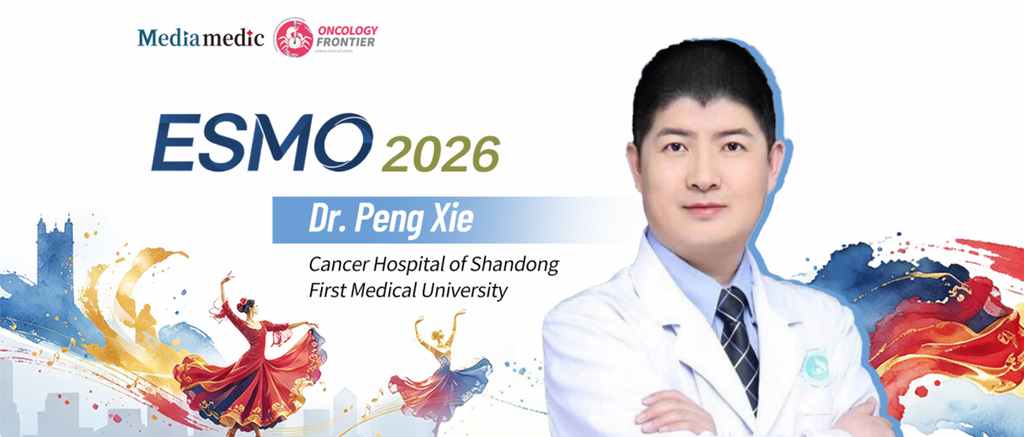
ESMO 2026 | Oligometastatic Cervical Cancer Study Reports Promising Results: QL1706 Plus Chemotherapy Followed by Definitive Radiotherapy Achieves an ORR of 90.91%

ESMO 2026 | Oligometastatic Cervical Cancer Study Reports Promising Results: QL1706 Plus Chemotherapy Followed by Definitive Radiotherapy Achieves an ORR of 90.91%

Patients with oligometastatic cervical cancer face a risk of systemic recurrence but may also benefit from aggressive local treatment. During ESMO 2026, results were reported from a Chinese single-arm Phase II study evaluating QL1706 plus chemotherapy, followed by definitive radiotherapy and continued immunotherapy maintenance. A total of 28 patients were enrolled. Among the 22 evaluable patients, the objective response rate (ORR) was 90.91%, and the disease control rate (DCR) was 100%. After a median follow-up of 8.25 months, median progression-free survival (PFS) had not yet been reached. Oncology Frontier invited Professor Peng Xie from Shandong Cancer Hospital and Institute, affiliated with Shandong First Medical University, to discuss the study design, efficacy findings, and safety management, and to share his perspectives on clinical practice.
ESMO LBA Insights | Pursuing Both Survival and Function: Professor Yue He Discusses the OPTIMAL Study

ESMO LBA Insights | Pursuing Both Survival and Function: Professor Yue He Discusses the OPTIMAL Study

In the treatment of head and neck cancers, particularly oral squamous cell carcinoma (OSCC), clinicians have long faced a difficult trade-off: achieving radical tumor control often requires surgery that sacrifices critical anatomical structures, including the tongue, floor of the mouth, and jawbone, all of which are essential for speech, swallowing, and appearance. To further reduce the risk of local recurrence, postoperative radiotherapy or concurrent chemoradiotherapy is frequently added. However, the resulting complications, such as trismus, xerostomia, dysphagia, and tissue fibrosis, can continue to impair patients' quality of life for years.
ESMO LBA Insights | Professor Jong Chul Park Discusses the HexAgon-HN Study

ESMO LBA Insights | Professor Jong Chul Park Discusses the HexAgon-HN Study

The 2026 European Society for Medical Oncology (ESMO) Congress was held in Madrid, Spain. During the Head and Neck Cancer Oral Presentation Session, the Phase II results of the HexAgon-HN study (LBA42) were presented. The study evaluated the efficacy and safety of the hexavalent OX40 agonist INBRX-106 plus pembrolizumab (P) versus pembrolizumab monotherapy as first-line treatment for recurrent or metastatic head and neck squamous cell carcinoma (R/M HNSCC) with a PD-L1 combined positive score (CPS) ≥20. The results showed that the objective response rate (ORR) in the combination group reached 48.3%, representing an absolute improvement of 21.8 percentage points over the monotherapy group (26.5%). The benefit was particularly pronounced in the HPV-positive subgroup (80.0% vs. 33.3%). This also represents the first positive proof-of-concept result from a randomized controlled trial of an OX40 costimulatory pathway agonist in cancer immunotherapy.
ESMO China Voice | Professor Li Wenbin: Breaking the Blood-Brain Barrier — Novel Targeted and Chemotherapy Regimens Bring a Survival Breakthrough for Recurrent Glioma

ESMO China Voice | Professor Li Wenbin: Breaking the Blood-Brain Barrier — Novel Targeted and Chemotherapy Regimens Bring a Survival Breakthrough for Recurrent Glioma

Recurrent high-grade glioma (HGG) has an extremely poor prognosis, particularly in IDH-wildtype patients, with a median overall survival (OS) of only 6–10 months. Despite progress in targeted therapy, the treatment of central nervous system (CNS) tumors remains a significant challenge due to the physiological barrier of the blood-brain barrier (BBB). At the 2026 European Society for Medical Oncology (ESMO) Congress, Professor Li Wenbin's team from the Neuro-Oncology Comprehensive Diagnosis and Treatment Center of Beijing Gaobo Hospital presented two research findings: a Phase I oral presentation on the novel BRAF inhibitor HSK42360 in recurrent glioma, and multicenter, large-sample prospective data on teniposide combined with platinum for recurrent HGG. On October 31, the 6th iHope Innovative Medicine Forum was held. With the construction of the ARO (Academic Research Organization) clinical research system as its core, the forum demonstrated Gaobo Hospital's strength in building a multinational, multicenter clinical research system and translating cutting-edge technologies. Oncology Frontier invited Professor Li Wenbin to interpret the breakthroughs in clinical translation of innovative drugs and the evolving landscape of neuro-oncology treatment from the perspectives of translational medicine and clinical research.
ESMO 2026 LBA | EGFR×HER3 Bispecific ADC Iza-bren Reshapes the Treatment Landscape of Advanced HR+/HER2− Breast Cancer, Becoming the First Chinese Innovative Drug in Breast Cancer to Be Published in The Lancet

ESMO 2026 LBA | EGFR×HER3 Bispecific ADC Iza-bren Reshapes the Treatment Landscape of Advanced HR+/HER2− Breast Cancer, Becoming the First Chinese Innovative Drug in Breast Cancer to Be Published in The Lancet

From October 23 to 27, 2026, the European Society for Medical Oncology (ESMO) Congress was held in Madrid, Spain. At the meeting, iza-bren (BL-B01D1), an innovative EGFR×HER3 bispecific antibody–drug conjugate (BsADC) independently developed by SystImmune, made a remarkable appearance with data from its pivotal Phase III PANKU-Breast01 study. As a first-in-class, new-concept therapeutic, the agent's prespecified interim analysis results were presented in full for the first time worldwide in a late-breaking abstract (LBA).
ESMO 2026 | Professor Wei Xu: From Tumor Shrinkage to Surgery—Exploring a New Neoadjuvant Treatment Strategy for Head and Neck Squamous Cell Carcinoma with Iparomlimab, Tovoricimab, and Chemotherapy

ESMO 2026 | Professor Wei Xu: From Tumor Shrinkage to Surgery—Exploring a New Neoadjuvant Treatment Strategy for Head and Neck Squamous Cell Carcinoma with Iparomlimab, Tovoricimab, and Chemotherapy

Neoadjuvant treatment for locally advanced head and neck squamous cell carcinoma (LA-HNSCC) must achieve tumor regression and improve the likelihood of surgery while minimizing the impact on organ function and quality of life. At the 2026 European Society for Medical Oncology (ESMO) Congress, preliminary results were reported from an exploratory study evaluating neoadjuvant iparomlimab and tovoricimab (hereafter referred to as the “combination antibody regimen”) plus nab-paclitaxel and nedaplatin. As of April 2026, 12 patients had been enrolled. The cohort included a relatively high proportion of patients with hypopharyngeal cancer, and most patients had a PD-L1 combined positive score (CPS) of less than 20. The study reported high objective response and pathological response rates. However, this was a small, single-arm exploratory study, and the findings require validation through controlled studies and long-term follow-up. Oncology Frontier interviewed Professor Wei Xu about the study design, interpretation of pathological response, appropriate patient populations, and functional outcomes.
ESMO LBA Insights | Professor Shaodong Hong Discusses TAISHAN-301: Doubling the Response Rate in Nasopharyngeal Carcinoma and Offering a New Later-Line Treatment Option

ESMO LBA Insights | Professor Shaodong Hong Discusses TAISHAN-301: Doubling the Response Rate in Nasopharyngeal Carcinoma and Offering a New Later-Line Treatment Option

Nasopharyngeal carcinoma (NPC), often referred to as the “Guangdong cancer,” is particularly prevalent in southern China. First-line treatment with gemcitabine plus platinum-based chemotherapy combined with a PD-1 inhibitor has become the standard of care. However, for patients with recurrent or metastatic (R/M) disease whose cancer progresses following immunotherapy and platinum-based chemotherapy, later-line treatment options remain limited. Treatment still relies primarily on single-agent chemotherapy, such as gemcitabine and docetaxel, with objective response rates (ORRs) of only 10%–30% and median progression-free survival (PFS) of approximately 3–4 months. An effective standard treatment for this setting has long been lacking.
ESMO 2026 | Interim Results from a Neoadjuvant Study in Locally Advanced Cervical Cancer: QL1706 Plus Chemotherapy, with 14 Patients Undergoing Surgery

ESMO 2026 | Interim Results from a Neoadjuvant Study in Locally Advanced Cervical Cancer: QL1706 Plus Chemotherapy, with 14 Patients Undergoing Surgery

Concurrent chemoradiotherapy remains the standard treatment for locally advanced cervical cancer. For high-risk patients with a substantial tumor burden, extensive local invasion, or lymph node metastases, rapidly reducing tumor burden early in treatment and creating favorable conditions for subsequent definitive therapy remain important clinical challenges.
ESMO 2026 Voices from China | Professor Li Zhang and Professor Hongyun Zhao’s Team Presents First Large-Scale Dataset on Novel EGFR/c-Met Bispecific ADC HS-20122

ESMO 2026 Voices from China | Professor Li Zhang and Professor Hongyun Zhao’s Team Presents First Large-Scale Dataset on Novel EGFR/c-Met Bispecific ADC HS-20122

For patients with EGFR-mutated non-small cell lung cancer (NSCLC), resistance following EGFR tyrosine kinase inhibitor (TKI) treatment is almost inevitable. The challenge becomes particularly pronounced when resistance develops to third-generation EGFR-TKIs, leaving patients with limited subsequent treatment options and a persistent need for improved efficacy. It is against this backdrop of unmet clinical need that a novel dual-targeted agent has entered the clinical spotlight: HS-20122, a bispecific antibody-drug conjugate (ADC) targeting both EGFR and c-Met.